
Cabinet washers for crates and industrial parts
FORCHEM industrial cabinet washers

How cabinet washers work and when to choose them
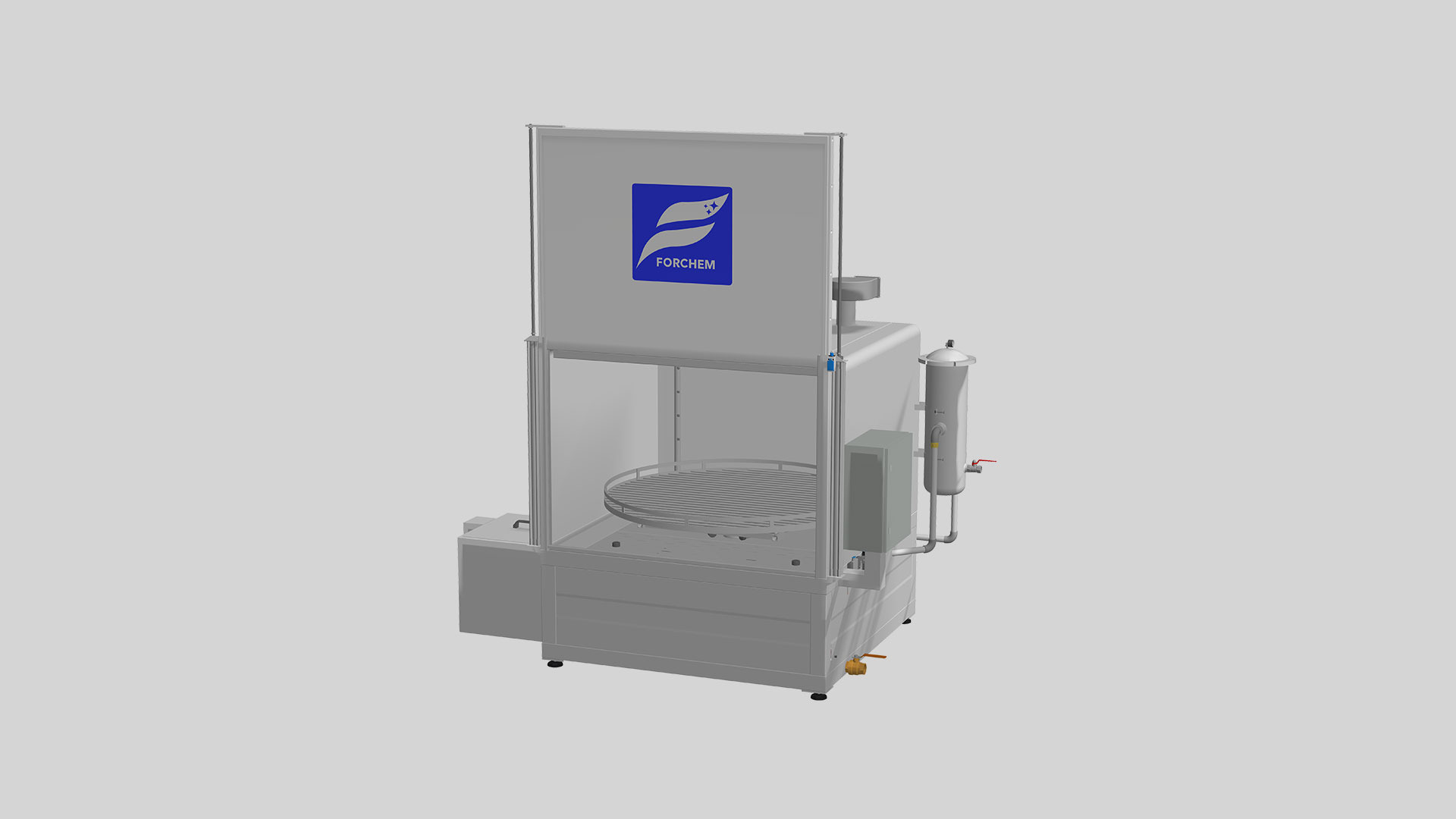
FORCHEM cabinet washers are designed for batch cleaning of components, tools and suitably positioned crates. On the KM 950, KM 1150 and KM 1650 models, a rotating basket and arranged spray nozzles help the washing solution reach different sides of the load. Actual results depend on component geometry, contamination and positioning.
Cabinet washer or tunnel washer?
Cabinet equipment can suit smaller production batches, changing part types or cleaning between manufacturing operations. For a consistent high-volume flow of similar crates, a tunnel washer may be more suitable. Required throughput, item size and the space available at the site all matter.
What do we check when specifying a system?
- Dimensions and weight: the item must fit the washing chamber and remain within the basket's permitted load.
- Spray access: orientation, fixtures and openings affect nozzle coverage and water drainage.
- Washing program: time, temperature and detergent are selected for the material, contamination and cleanliness requirements.
- Handling and drying: loading arrangements and any additional drying are assessed for the specific machine and downstream process.
KLT containers, industrial trays and non-standard inserts cannot be assumed suitable for every cabinet model. We assess such applications individually. Explore our equipment range or send your technical requirements.
Washing non-standard crates and industrial parts
Cabinet washing of non-standard crates, trays and components
For non-standard crates, industrial trays, blister inserts and components, external dimensions alone are not enough. How an item is secured in the basket, whether solution reaches recesses and whether water can drain after the cycle all matter. Delicate surfaces or difficult contamination may call for a washing trial.
Information needed to specify a cabinet washer
- Item details: dimensions, weight, material and photos showing the underside, ribs and recesses.
- Contamination: for example oil, grease, dust or process residues.
- Cleanliness target: downstream use, rinsing and permitted residual moisture.
- Batch and throughput: number of items per cycle, cycles per shift and loading method.
- Site constraints: handling space, door opening and utility connections.
Depending on the load, we may assess the KM 950, KM 1150 or KM 1650. The KMV 1200 is a different solution for handling and LASKA trolleys rather than a standard rotating parts basket.
Need a proposal? Send us photos, dimensions, contamination details and required throughput so we can assess the equipment for your application.
Products
FORCHEM cabinet model comparison: the KM 950 has an 800 mm basket diameter and a maximum item weight of 200 kg. The KM 1150 has a 1,000 mm basket diameter and 400 kg basket capacity. The KM 1650 has a 1,500 mm basket diameter and a maximum item weight of 1,000 kg. These figures come from the product specifications; the dimensions and positioning of your actual load must also be checked.
The KMV 1200 is designed for handling and LASKA trolleys and cannot be compared with rotating-basket machines by basket diameter alone. Ask us to assess the best configuration.


